



Eighty years ago, the Third Reich began implementing a plan for war against the Soviet Union (“Operation Barbarossa”) that had been in preparation for several months. On 11 July 1941, less than three weeks after the outbreak of war, the Wehrmacht High Command (OKW) announced: “…the total number of prisoners taken so far on the Eastern Front has risen to over 400,000. The number of enemy equipment captured or destroyed has risen to 7,615 tanks and 4,423 guns. The Soviet Air Force has so far lost a total of 6,233 aircraft.” Goebbels’ propaganda immediately seized upon these figures, presenting to the world the magnificent successes of the German army in its clash with the hated Bolshevism. Photojournalists from the Propagandakompanie were sent to the front, their task being to leave a record for posterity of just how deadly effective the German weapon could be.
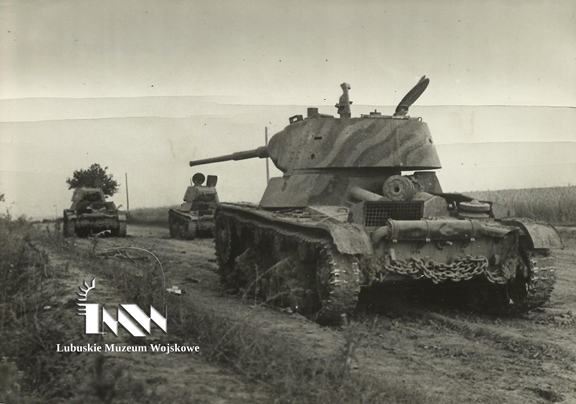
July 1941 – on a dirt track, somewhere in Belarus. Three abandoned Soviet T-26 Model 1939 light infantry support tanks, equipped with 45 mm 20K Model 1934 guns. The vehicle in the foreground has non-standard paintwork in warm green, sand and brown (black?). On the engine plate are two spare road wheels with rubber tyres. In June 1941, the Red Army’s armoured forces had over 11,000 T-26 tanks of various versions at their disposal. They were produced between 1931 and 1941 at the K. Voroshilov Plant No. 174 in Leningrad (St Petersburg).

Summer 1941 – a 52-tonne Soviet KW-2 heavy tank, immobilised and abandoned on the Red Army’s retreat route. The vehicle was designed to destroy permanent and field fortifications, as well as anti-tank barriers. The turret is mounted with a 152 mm model 1940 (ML-10S) howitzer. Between 1940 and 1941, 204 KW-2 tanks were produced at the Kirov Works in Leningrad (St Petersburg). Virtually all were lost in action, due to numerous breakdowns, lack of fuel or becoming bogged down in marshy terrain.
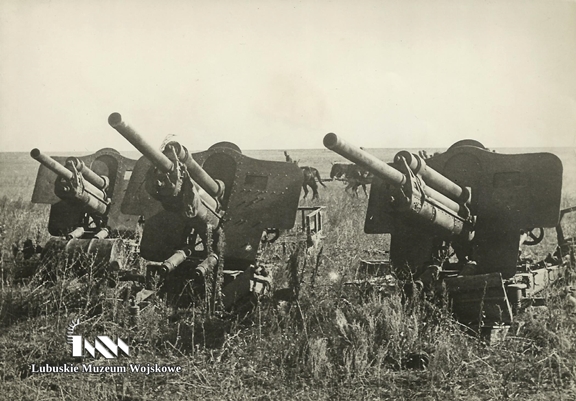
Summer 1941 – Soviet USW model 1939 76 mm divisional guns abandoned on the Ukrainian steppe. Serial production of these guns began in 1939 at Plant No. 92 in Gorky (Nizhny Novgorod), and later at Plant No. 221 ‘Barrikady’ in Stalingrad (Volgograd). On 22 June 1941, the Red Army had 1,170 guns of this type in service.

Summer 1941 – a German depot of captured military equipment. In the foreground, a 152 mm wz. 1937 (ML-20) self-propelled howitzer. At the start of the Soviet-German War, the Red Army had just over 2,600 of these guns. In the background, 122 mm wz. 1931 (A-19) heavy field guns. They were mainly used to destroy fortifications, artillery positions and troop concentrations. On 22 June 1941, the Russians had 1,255 guns of this type in service (including the 1931/37 model). After their capture, they were used by the Wehrmacht until the end of the war, including on the Atlantic Wall.

A Soviet armoured train of the 76th Regiment of the 3rd NKVD Division (commander V.A. Kononienko), destroyed in action on 27 June 1941 near the town of Smolevichi in Belarus, within the operational zone of the Western Front. A ‘black’ steam locomotive of the ShCh series, type 1-4-0 (one leading bogie, four driving axles, no trailing bogie) – one of over 1,900 units produced back in Tsarist Russia at one of the major locomotive-building works (Kharkiv?, Bryansk?, Kolomna?) Behind the locomotive is an MBW D-2 armoured motor car manufactured at Plant No. 1 at the Lyublino station near Moscow. A 76 mm calibre Model 1902 cannon is mounted in the turret. On the starboard side are two heavy 7.62 mm calibre Maxim Model 1910 machine guns.

A quadruple-mounted Soviet M4 anti-aircraft gun, model 1931, mounted on the flatbed of a GAZ-AAA truck. The cooling hoses and magazines for 500-round belts (instead of the standard 250-round ones) are visible. Weighing approximately 500 kg and with a rate of fire of 1,200–2,000 rounds per minute, the M4 was designed to engage aircraft flying at speeds of up to 500 km/h at altitudes of up to 1,400 m. It was also used to fire on ground targets. It was set up as a fixed installation or mounted on, amongst other things, naval vessels and railway platforms. Manufactured at the Tula Arms Plant.
Text: Tadeusz Blachura
Photographs: LMW Drzonów collection