




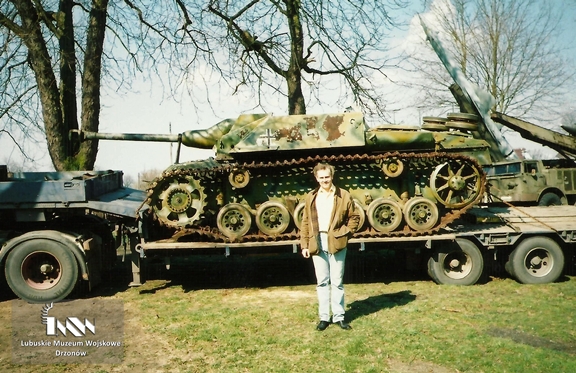
February 2003 – the author posing next to the StuG in the outdoor exhibition at the museum in Drzonów (photo: J. Sobociński)
In 2002, from the bottom of the Black Sea – specifically from the Kalamich Bay on the western side of the Crimean Peninsula – a Ukrainian exploration company recovered a German StuG III assault gun from the wreck of a sunken transport vessel. The wreck, lying at a depth of around 21 metres, had been located many years earlier (in 1975?) and identified as the passenger and transport steamship “Santa Fe”, which sank during the Second World War.
The ship, originally named “Steigerwald”, was built in 1921 at the Deutsche Werft AG Betrieb Finkenwärder shipyard in Hamburg. It sailed the Atlantic between Europe and ports in North and South America. In 1937, it was renamed “Santa Fe”. In the first weeks of the war, the ship was moored in the port of Rio de Janeiro. In October 1939, whilst attempting to return to its home port in Germany, it was intercepted by two French destroyers and, under the new name “Saint André”, subsequently sailed under the French flag. In 1942, it fell back into German hands and, under its old name “Santa Fe”, was deployed to the Black Sea in 1943. The ship was over 126 m long, over 15 m wide and had a draught of 8.2 m. It was a two-deck vessel with a single propeller, had a tonnage of 4,627 GRT and reached a speed of 12 knots.
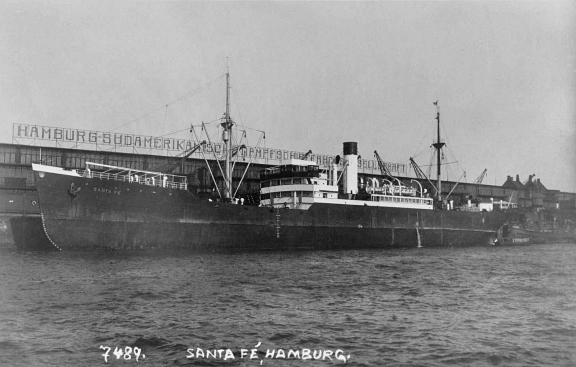
Fig. 2: The Santa Fe in the port of Hamburg in the late 1930s (source: Wikipedia)
In the autumn of 1943, on the south-western section of the Eastern Front (from the Pripyat River to the Kerch Peninsula), both sides concentrated their largest forces. The Red Army had just over 40% of its infantry divisions and around 80% of its armoured and mechanised units here. The Germans, meanwhile, had around 40% of their infantry divisions and around 70% of their armoured and motorised divisions. At that time, the Russians launched a large-scale offensive aimed at liberating southern Ukraine and blocking German forces in Crimea. By the end of 1943, the three Ukrainian fronts had achieved this objective. Despite the dire strategic situation, the Nazi command decided that the peninsula must be held at all costs and by any means necessary, so that the Red Army could not use it as an important airbase from which to launch strikes against the oil-rich regions of Romania, as well as a bridgehead for landing operations on the Romanian and Bulgarian coasts. General Erwin Jaenecke’s German 17th Army, stationed in Crimea, and the Romanian divisions were making intensive preparations to repel the imminent Russian offensive. Cutting off the Germans from land links to their supply bases led to an intensification of supplies to the peninsula by sea.
In the early morning of 23 November 1943, south of the headland near the town of Yevpatoria, the ships and warships of the ‘Wotan’ convoy, sailing from the Romanian port of Constanța to Sevastopol in Crimea, appeared. These were the transport ships “Santa Fe” and “Lola”, escorted by the Romanian destroyer “Marasti”, the Romanian minelayer “Admiral Murgescu” and three German minesweepers. On board the “Santa Fe” were 1,278 tonnes of military cargo, including artillery shells, aircraft bombs, fuel in barrels, 12 StuG III assault guns and 2 combat vehicles identified as Jagdpanzers (likely pre-production series Jagdpanzer IVs armed with a 75 mm Pak 39 L/48 cannon). Shortly before 06:00, an explosion occurred in the area of the ship’s forward hold, causing a fire. Half an hour later, a second explosion took place. The transport ship broke in two and sank along with its cargo. Twenty-eight people were killed (22 of them were members of the assault gun crews intended to reinforce Sturmgeschütz-Abteilung 191 or Sturmgeschütz-Abteilung/Brigade 279), and 16 were missing. Seventy-eight people were rescued, 11 of whom were seriously injured. Initially, it was believed that the ‘Santa Fe’ had been torpedoed by the Soviet ‘Dekabrist’-class submarine D-4. A radiogram reporting the torpedoing of the ship was sent to headquarters by the German seaplane Arado Ar 196, which was circling the convoy. However, it is more likely that the transport struck a mine “laid” several months earlier by a Soviet submarine. Interestingly, three weeks later, in almost the exact same spot, the German submarine hunter Uj-102 (a vessel converted from a small KT-class transport ship) sank – along with its entire crew. The cause was a powerful underwater explosion. It was thought that the hunter had mistakenly taken the transport ship “Santa Fe”, lying on the seabed, for a Soviet submarine and dropped depth charges on it, causing the ammunition left in the wreck to detonate. However, a more likely explanation is that the Kriegsmarine vessel – like the “Santa Fe” – struck a mine.
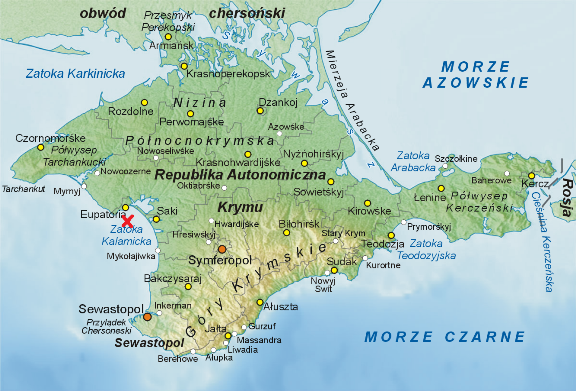
Approximate location of the sinking of the transport ship Santa Fe (map source: Wikipedia)
The remains of both wrecks have lain on the seabed of Kalamiki Bay for over eighty years, at a depth of around 21 metres and 250 metres apart. They have long been of interest to divers and are frequently explored. In 2000, two (three?) StuG III assault guns were salvaged (unfortunately using barbaric methods!) – including one in relatively good condition, which was identified as a ‘G’ version fitted with a cast Saukopfblende gun mantlet. The vehicle was transported to Sevastopol (Strzeleć Bay), where it was cleaned of accumulated layers of silt, seaweed and rust, painted in a three-colour camouflage scheme and put up for sale. The SdKfz Military Vehicle Foundation from the UK took an interest in it. The assault gun was transported to Poland and on 30 January 2003 was temporarily housed at the museum in Drzonów, where it awaited the completion of all legal formalities related to the purchase and export of the vehicle abroad.
The StuG III – considering it had lain on the seabed for so many years – was in relatively good condition. However, it was missing many pieces of equipment, including mudguards, a Notek-type track light, and armoured side skirts against shaped-charge projectiles. The roof of the fighting compartment was also missing. As a result of the explosion, a section of armour had been torn away, along with the commander’s observation turret, the loader’s hatch and the armoured cover for the machine gun. Cracks in the armour were visible, as was a large loss of steel near the driver’s observation slit (right next to the left drive wheel). A clear breach and buckling of the armour plate could be seen beneath the Saukopfblende. The StuG’s floor was heavily cracked, and a large section of it had collapsed. The road wheels with rubber tyres bearing manufacturers’ markings (Continental, Semperit, Metzeler, Dunlop) and the idler rollers were fitted with single-grouser tracks 400 mm wide, made of manganese steel at the Deutsche Eisenwerke Aktiengesellschaft works in Mühlheim in the Ruhr region. On the breech block of the excellent StuK 40 L/48 75 mm gun, the number R 785 has been preserved, and on the side inner wall – to the left of the driver’s seat – the number 959(8?) 25, indicating that the assault gun was manufactured in early November 1943 at the MIAG (Mühlenbau und Industrie AG) works in Braunschweig. The manufacturer was also identified by the characteristic pattern of the anti-magnetic (or rather non-magnetic!) Zimmerit coating, remnants of which remain on the vehicle. The production date suggests that at least this vehicle arrived by rail at the port of Constanta and was loaded onto the ‘Santa Fe’ straight from the assembly line.
The StuG III assault gun, which had been ‘parked’ in Drzonów for over a year, aroused considerable interest among enthusiasts of German armoured vehicles and model-makers from all over Poland – and beyond. At the time, it was the first vehicle of its kind in Polish collections that one could truly ‘experience’ up close. Admittedly, it lacked a roof panel, but this provided an unobstructed view of the fighting compartment for photographers of all kinds and model-makers who loved the finest details.
In the spring of 2004, the assault gun left Drzonów for its new owner’s premises. Michael Gibb oversaw the completion of all the formalities; the author of these words had the pleasure of meeting him and engaging in an interesting conversation about the StuG and other topics. I never had any further contact with him after that. Sadly, two months ago I learnt that Michael Gibb had died suddenly on 20 October 2024 whilst visiting his family in South Africa. It is a great loss, as he was only 62 years old, and so was slightly older than me! The news was reported on the website of The Weald Foundation (formerly The SdKfz Military Vehicle Foundation), of which the late Michael Gibb had been the founder, director and trustee since 2003. The Foundation’s mission is to restore historic military vehicles from both the First and Second World Wars to their former glory and preserve them for future generations. Furthermore, it is involved in educating the public about their history and role in armed conflicts. It is based near London (Yalding in the county of Kent), where one of the most interesting collections (30 items) – often very rare – of tracked and wheeled combat vehicles, all in excellent condition, is housed.
March 2004 – Michael Gibb posing in front of the StuG shortly before leaving LMW Drzonów for the UK (photo: T. Blachura)
After being transported to the British Isles, this armoured relic underwent a comprehensive five-year restoration, involving many people and requiring a huge financial outlay. Many parts of the StuG’s structure were missing, and many of those that had survived were unusable. The missing parts were replaced through purchases or exchanges, drawing on extensive contacts with collectors across Europe. Many components were fabricated in-house, modelled on borrowed originals or based on German technical documentation from the war period. Ultimately, the vehicle was restored to the configuration in which it likely left the assembly halls of the factory in Brunswick in the autumn of 1943. The hull and superstructure were coated with 70 kg of multi-component Zimmerit, 5 mm thick and grooved into small squares – a pattern characteristic of the MIAG works. The rough, anti-magnetic (or rather non-magnetic!) Zimmerit was used by the Germans from August–September 1943 until September 1944 and was intended to prevent the enemy from attaching magnetic mines to the hull. The sides of the StuG, meanwhile, were protected by 5 mm thick armour plates – reconstructed in-house. These protected the vehicle from fire from Soviet 14.5 mm anti-tank rifles and were intended to mitigate the effects of shaped-charge projectiles. Finally, the assault gun was painted uniformly with a base coat of Dunkelgelb (officially used by the Wehrmacht from February 1943) – the same colour used on combat vehicles leaving the factory. The actual camouflage was only applied in the units of origin, adapting it to the season and the terrain in which the StuGs fought bloody battles.
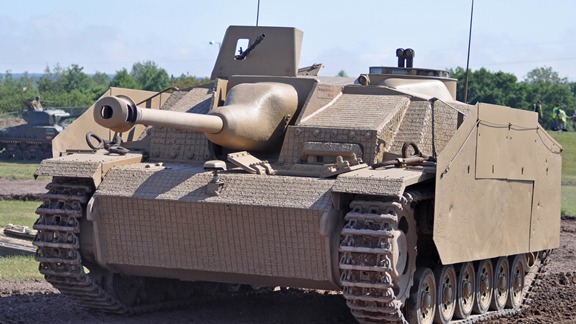
StuG III Ausf. G from the transport ship Santa Fe – following restoration, the vehicle is fully assembled and in perfect working order. Tankfest Bovington, 2009 (source: Internet)
The StuG’s first public appearance following its restoration took place at the end of June 2009 during the annual Tankfest event organised by the Tank Museum in Bovington, Dorset. The StuG was then showcased in all its glory during a dynamic display. After almost seven decades, its engine roared to life once more, and the vehicle’s tracks left their mark on the museum’s parade ground. The delighted crowd of armoured vehicle enthusiasts, who had travelled to the displays from far-flung corners of the world, repeatedly rewarded one of the most successful German combat designs of the Second World War with thunderous applause.
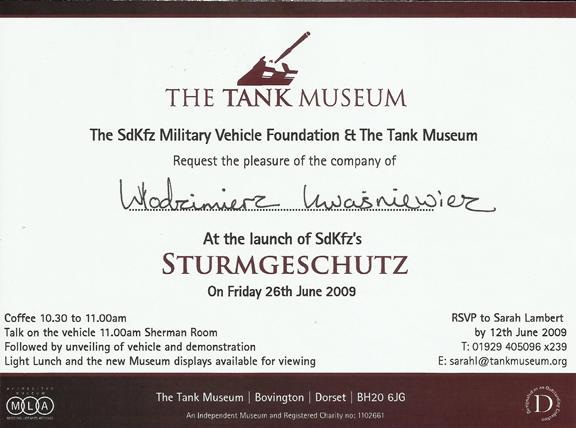
An invitation to the then director of the LMW Drzonów, Dr W. Kwaśniewicz, to the first presentation of the StuG following its refurbishment (LMW collection)
The StuG III Ausf. G assault gun was the last, and at the same time the most popular, version of vehicles of this type. Alkett Berlin-Borsigwalde began production in December 1942, and in February 1943, MIAG in Braunschweig joined the effort. By the spring of 1945, around 8,500 vehicles had rolled off the production lines (MIAG built 2,600 StuGs). Weighing 24 tonnes, the combat vehicle was armed with a long-barrelled, semi-automatic 75 mm StuK 40 L/48 gun with a ammunition supply of 54 rounds. The 4.1 kg PzGr. 40 sub-calibre anti-tank shell, with an initial velocity of 920–1,060 m/s, could penetrate 87 mm of armour at a distance of 1,000 m when the armour was at a 90° angle. Thanks to their low profile, effective gun, fairly good armour and manoeuvrability, the StuGs were able to successfully engage targets at medium ranges, including Soviet T-34 tanks (German vehicles performed better in defence than in attack!). In the final months of the war, assault guns were introduced on a wider scale into many armoured divisions, where they supplemented the PzKpfw IV and PzKpfw V ‘Panther’ tanks. They were also frequently assigned to tank destroyer squadrons. They thus served as a ‘fire brigade’, dispatched urgently wherever things were getting really ‘hot’.
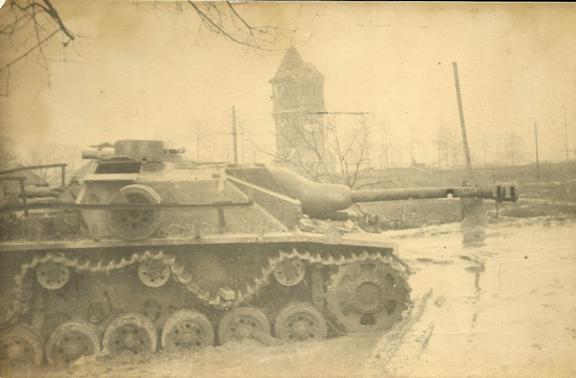
Eastern Front, autumn 1944 – a damaged late-production StuG III Ausf. G (featuring, among other things, steel road wheels and a machine gun position operated from inside the vehicle) (photo: T. Blachura’s private collection)
Text: Tadeusz Blachura