



Janina Wolanin (née Błaszczak) was born on 5 October 1924 in Kovel, Volhynia. In the military settlement of Polany, situated about 20 km north-east of Kovel, her father – a former legionnaire and participant in the Polish-Bolshevik War of 1920 – Corporal Jan Błaszczak ran a farm. Following the occupation of the Eastern Borderlands in September 1939, he was severely beaten by Ukrainian nationalist militias. After being taken to hospital in Kovel, he disappeared without trace.
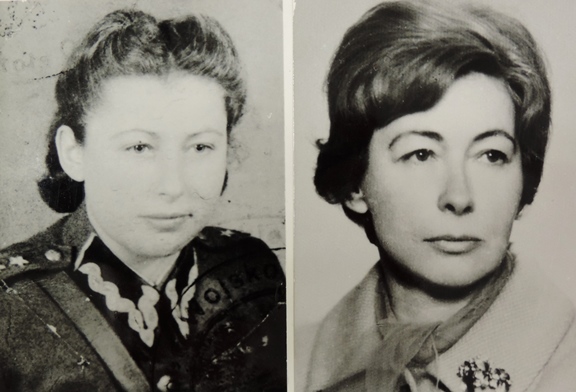
A photograph of Janina Błaszczak (née Wolanin) in a Polish Army lieutenant’s uniform (1945) and a post-war photograph (LMW Drzonów archive)
In February 1940, the teenage Janina Błaszczak, together with her brother, mother and grandfather, was deported by the Soviet authorities to Siberia, where she worked clearing forests. She was one of 140,000 Poles deemed by the Soviet authorities to be an “unsafe element” and deported deep into the Soviet Union.
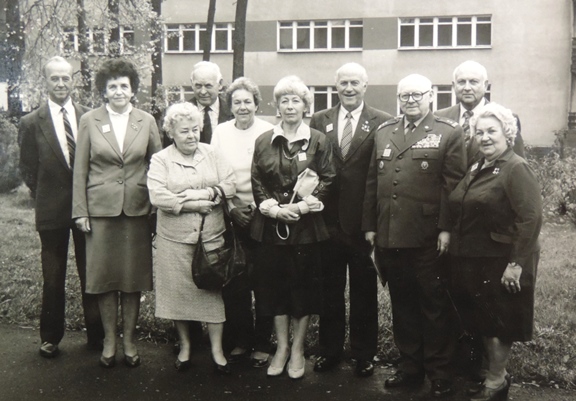
The 5th National Gathering of the ‘Riazańczycy’ in Poznań, 1987 – Janina Wolanin in the centre (LMW Drzonów archive)
In the summer of 1943, upon hearing that the Polish 1st T. Kościuszko Infantry Division was being formed in Sielce nad Oką, Janina Błaszczak volunteered for the army and was assigned to the Emilia Plater Women’s Battalion. In September, she was sent to the Infantry Officers’ School in Ryazan to join a mortar platoon. In February 1944, she passed her exams, coming third out of several hundred cadets (including 51 women), and was promoted to second lieutenant. Her strong character traits, such as courage, determination, organisational skills, as well as physical and mental resilience, led to her being entrusted with the role of commander of a male 82 mm mortar company (3rd Company of the 9th Infantry Regiment of the R. Traugutt 3rd Infantry Division). It was the largest unit commanded by a woman on the front line during the Second World War!
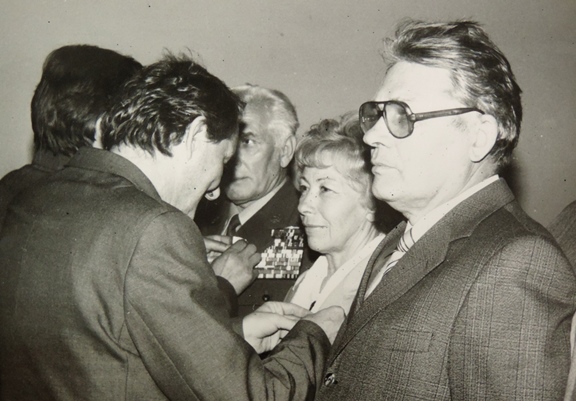
Meeting of the Association of Former Professional Soldiers in Krosno nad Odrą, 7 October 1988 – in the centre, Janina Wolanin being awarded the ‘Rodło’ Medal (LMW Drzonów archive)
Second Lieutenant Janina Błaszczak and her subordinates saw their first combat in August 1944 during the defensive battles on the Wareck-Magnuszew bridgehead. In mid-September, the 3rd Infantry Division arrived in Warsaw and took up positions on the right bank of the Vistula. Its 9th Regiment (including the mortar crews of the 3rd Company) was to cross the river into Powiśle to assist the fighting insurgents. The crossing took place with heavy losses, and the fighting on the Czerniakow bridgehead itself was extremely fierce. It was here that Second Lieutenant Janina Błaszczak was wounded in the legs whilst defending one of the insurgent barricades. Massed German attacks forced the insurgents, the ‘Berling’ troops and the civilian population to make desperate attempts to evacuate to the right bank of the Vistula. Soldiers attempted to evacuate the wounded Janina Błaszczak in one of the surviving landing craft, but a nearby explosion of an artillery shell wounded her again – this time in the head. Eventually, along with other insurgents and soldiers, she was taken prisoner. She was transported to a hospital in Skierniewice, from where, after a few days, Home Army nurses secretly smuggled her out and placed her with a railway worker’s family, where she was hidden and treated for several months. In early 1945 – after the front had passed through Skierniewice – she went to Lublin to the Polish Army headquarters. There, too, she underwent several months of specialist treatment. She was then sent to the Central School for Political and Educational Officers in Łódź, where she served as assistant to the head of frontline training. In March 1946, at her own request, she was demobilised.
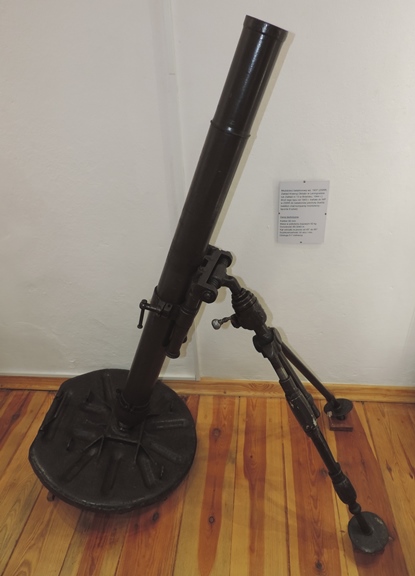
An 82 mm model 1937 battalion mortar. This weapon was operated by the subordinates of Second Lieutenant Janina Błaszczak (collection of the Drzonów Military Museum)
After the war, Janina Błaszczak married Captain Józef Wolanin and eventually settled in Zielona Góra. She had two children, obtained a secondary education in economics, and graduated from the College of Economics and Industry in Warsaw. She worked as a highly qualified accountant until her retirement in 1981. In the years that followed, she devoted herself entirely to social activities for war veterans, organising numerous reunions of ‘Riazań’ veterans – such as those in Szczecin and Świnoujście in June 1989. She was chairwoman of the Regional Council of Women Veterans in Zielona Góra. It was thanks to her commitment that, in October 1989, a permanent exhibition dedicated to female soldiers was organised at the Lubuskie Military Museum in Drzonów (the only one of its kind in Polish military museology at the time). On Janina Wolanin’s initiative, an obelisk dedicated to all Polish female soldiers who fought on the fronts of the Second World War was unveiled at the Municipal Cemetery in Zielona Góra in 2000. It was also thanks to her that a temporary exhibition entitled “Polish Women Soldiers – Participants in the Second World War” was organised at the Lubusz Land Museum in Zielona Góra in the spring of 2003. The Lubusz Military Museum in Drzonów also participated in the preparation of the exhibition.
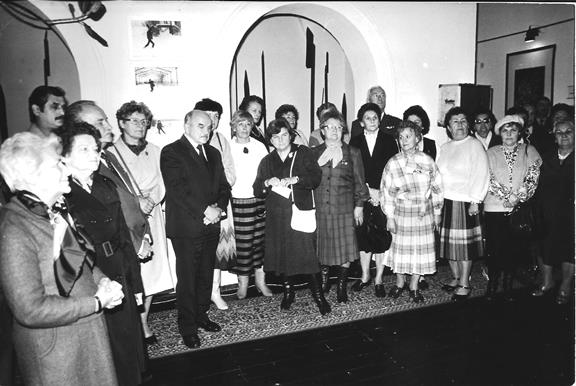
The opening of the permanent exhibition ‘Women Soldiers’ at the Drzonów Museum (29 October 1988). Janina Wolanin stands by a pillar wearing a skirt with dark horizontal stripes. Next to her is Zbyszko Piwoński, then Governor of Zielona Góra, who had established the Lubusz Military Museum three years earlier (LMW Drzonów archive)
Janina Wolanin died on 22 December 2010 at the age of 86. She was buried with military honours in the Avenue of Merit at the Municipal Cemetery in Zielona Góra, accompanied by colour guards and attended by representatives of the municipal authorities and veterans’ organisations.
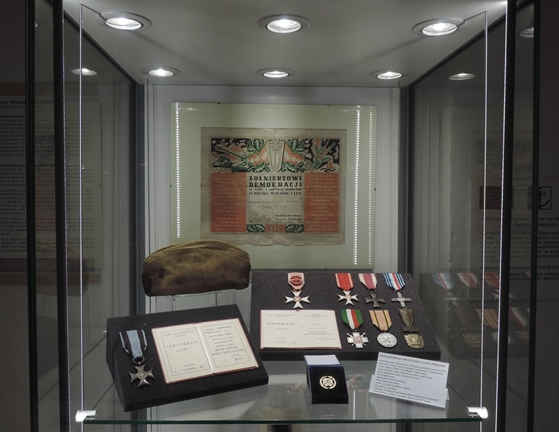
Memorabilia belonging to Janina Wolanin, on display at the Drzonów Museum as part of the permanent exhibition “Women Soldiers” (a cloth cap, the Virtuti Militari War Order, the Officer’s Cross of the Order of Polonia Restituta, etc.) (collection of the Drzonów Local History Museum)
For her service and heroic deeds during the war, Janina Wolanin was awarded high state honours – the Silver Cross of the Virtuti Militari War Order, the Officer’s Cross of the Order of Polonia Restituta, the Knight’s Cross of the Order of Polonia Restituta, the Cross of Valour, as well as the Warsaw Uprising Cross, the Siberian Exiles’ Cross, and the gold badge of the “Association of War Disabled of the Republic of Poland”. In 2003, for her active community work on behalf of Zielona Góra and the region, she was awarded the title of Honorary Citizen of Zielona Góra by the City Council. Among her many honours, Janina Wolanin also held the gold badge “For Services to Warsaw”.
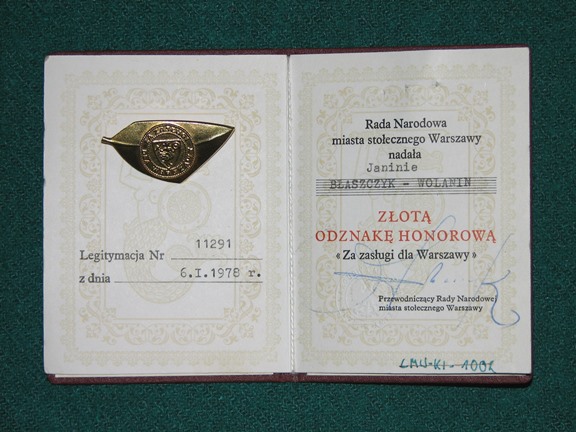
Gold badge “For Services to Warsaw” with accompanying ID card – Janina Wolanin’s maiden name is misspelled (it should be Błaszczak) (collection of the LMW Drzonów)