



Two centuries have passed since the foundation of the Neoclassical palace in Drzonów was laid on what is known as ‘bare ground’. Due to a lack of source material regarding the exact date of its construction, the year 1816 is generally accepted as the year in which the construction of this Drzonów residence of three German landed families was completed. This date appears on the tympanum of the palace’s northern façade and marks the beginning of its history.

Drzonów (Drehnow, Schlesisch Drehnow) is first mentioned in historical sources as early as the beginning of the 14th century. In the Middle Ages, there was an estate here comprising a farmstead and a church. The owners of the Drzonów estate were, in succession, the lords of Kosierz, Letnica and Nietków. In the first half of the 17th century, it passed into the hands of the von Misitschek family for over two centuries.
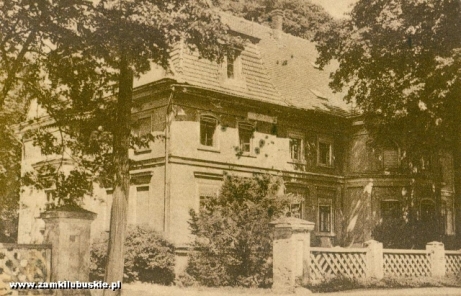
The south-western corner of the palace on a German postcard from the 1920s. Visible are the whitewashed openwork fencing surrounding the palace and park grounds, and one of the two entrances to the estate.
In the second decade of the 19th century, an unnamed member of the von Misitschek family initiated the construction of a palace in Drzonów. It was intended to be a more imposing residence than the previously existing manor house, the location of which remains shrouded in mystery to this day. The architecture of this stately residence, built in the Classical style, suggests a connection between its unnamed designer and the circle of the German architect David Gilly (1748–1808), who was active in Prussia. Built on an elongated rectangular plan (30 m x 15 m) and topped with a high gable roof, the building was – in keeping with the fashion of the time – set back from the farm buildings. These buildings were situated in the western and northern parts of the estate, which also included a magnificent landscape garden with a pond.
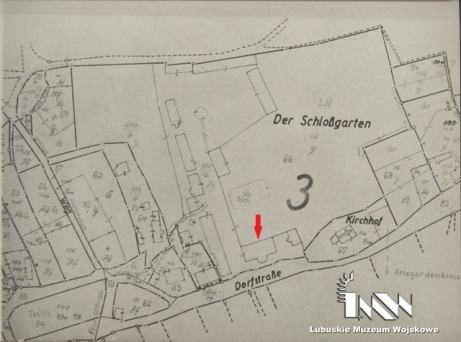
The location of the palace on a German site plan of the knightly estate dating from the late 1930s.
In 1853, the Drzonów estate, together with the palace, was purchased by Karl Leonard von Klinckowström – a member of the old nobility originating from Swedish Pomerania. Following his father’s death in 1865, the estate passed to his eldest son, Ernst Karl Thure von Klinckowström, who was responsible for the palace’s reconstruction in 1868 (this date also appears on the tympanum of the north façade). For two decades (1867–1887), Thure served as the starost of Zielona Góra, and it is reasonable to assume that the reconstruction – of a residence that was, after all, not so old – was driven by a desire to give it more representative features. Thus, polygonal projections reaching up to the crowning cornice were added to the main body of the palace (south and east façades), a bay window with a balcony was added (west façade), and the shape of the apparent projection on the north façade was radically altered. The palace interiors were also remodelled, but despite certain changes, they retained their original layout.
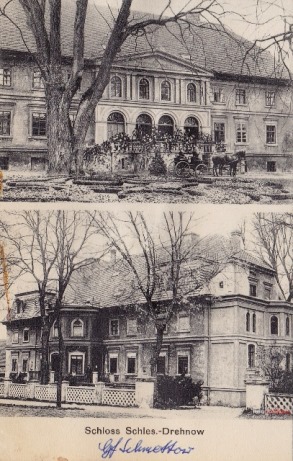
The north and south façades of the palace on a German postcard from the 1930s.
Thure died in November 1901. The following year, the substantial estate passed to the von Schmettow family – his eldest daughter Maria had married Bernhard Gottfried Willibald von Schmettow in October 1878. She initially managed the Drzonów estate together with her husband, and after his death in December 1927, she managed it alone. She died in the late 1930s, leaving the estate to her son Gottfried, who remained its owner until the winter of 1945. Formally, the last ‘lord of Drzonów’ was Bolko, Gottfried’s son from his first marriage, who was born in Sulechów (Züllichau) and died in the Federal Republic of Germany in September 2008, having reached the ripe old age of 95.
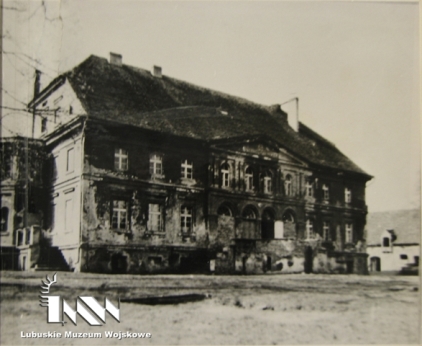
A view of the palace’s north façade in the 1950s (?). On the right, a section of the (now defunct) largest farm building on the Drzonów estate.
The turmoil of war and the advent of the ‘new’ era brought an end to Drzonów’s German heritage. After 1945, the 1,023.42-hectare estate, comprising arable land, meadows, forests, as well as a distillery, a windmill, a brickyard and four farmsteads – Lach-vorwerk (Henriettenhof), Alt-vorwerk, Neu-vorwerk (Dorotheenhof), Lamphanswinkel – was taken over by the State Treasury.
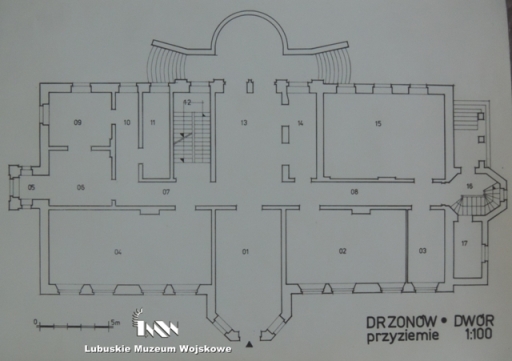
The ground floor plan of the palace, where the main entrance to the building is currently located on the south side and where permanent and temporary exhibitions of military artefacts are housed.
Located in the centre of the village, the palace is built – as mentioned earlier – on a rectangular plan measuring 30 m x 15 m, and its total height is 17 m. The two-storey main body rests on cellars raised above ground level, which form its plinth. The storeys are separated by a wide cornice and are of varying heights. The higher ground floor suggests that this is where the state rooms were once located, where the social life of the estate’s owners took place. Today, the ground floor houses permanent and temporary exhibitions, for which the interior décor has been slightly altered. The lower floor originally had the same layout as the ground floor, but after 1945 this layout was adapted to the building’s new functions. Today, it houses museum offices and storage areas. The floor is crowned by a solid cornice, above which rises a gable roof with pediments, over 8 metres high. On the south side, it features two tiled bay windows, which formerly each had a large vertical rectangular dormer and were topped with an ornate wrought-iron balustrade.
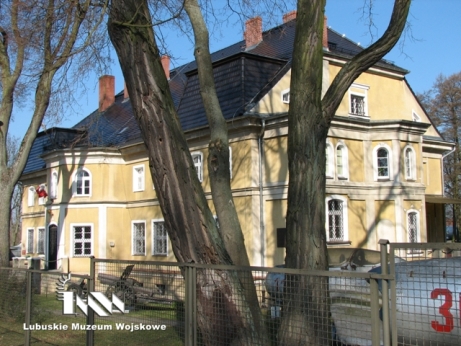
The south-east corner of the palace, with its prominent projections and cornices – the inter-storey and the crowning cornice.
The palace’s reconstruction in 1868 revitalised the austere architecture of the Classical building. ‘Extensions’ were added to three of the façades, reaching the level of the crowning cornice. On the south side, this was a pentagonal projection with windows featuring semicircular arches on the upper storey. Today, this houses the main entrance to the museum. On the east side, an annex with a projection was added, featuring segmental-arched windows on the ground floor and round-arched windows on the first floor. The projection contains the ‘kitchen entrance’ to the palace and a staircase with a single flight of wooden steps. On the west side, a basemented bay window with windows was added, topped by a balcony with a balustered balustrade, and fluted pilasters topped with Corinthian capitals were added to the corners for decorative effect.
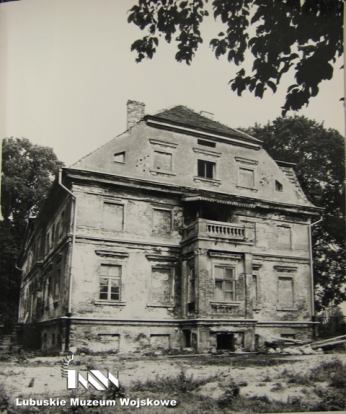
The west façade of the palace, featuring a bay window topped by a balcony. Condition as of the early 1980s.
However, the most impressive is the palace’s northern façade, where the main entrance was located in its heyday. It has eleven axes and is divided into three sections, the central one being a false avant-corps topped with a triangular tympanum. The tympanum bears the dates MDCCCXVI–MDCCCLXVIII, separated by a medallion bearing the monogram TK and a seven-pointed crown. The ground-floor projection has four arcades – the two central ones formerly served as the main entrance to the palace, one at each end led to a staircase, and the other at each end to a vaulted section with arcades. The outer arcades are currently bricked up and covered with bas-reliefs featuring military motifs. The projection on the first floor has four semi-circular arched windows, between which there are paired pilasters (the central one is single). In front of the false projection is a rather massive, semi-circular terrace with a basement, featuring mirrored stairs and ventilation openings, which was originally topped with a balustered brick (or concrete?) balustrade.
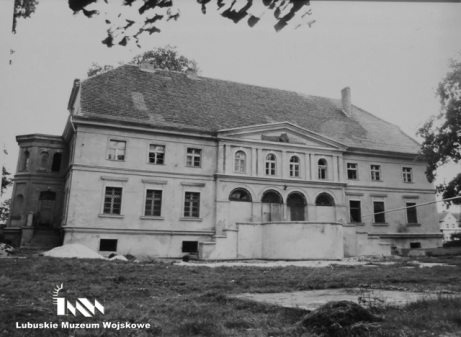
The north façade of the palace, featuring a central projection topped with a tympanum. As seen in September 1983, whilst renovation work was still underway.
The events of the Second World War meant that in the winter of 1945, faced with the approaching ‘Bolshevik plague’, the von Schmettow family left their estate and moved across the Elbe. The estate was seized by the Russians and subsequently taken over by the State Treasury. In September 1945, settlers from central Poland and displaced persons from the Eastern Borderlands, particularly from the Drohobych area, began arriving in Drzonów. The palace housed a school and accommodation for teachers, and for a time also served as the offices of the Municipal Cooperative. The estate’s farm buildings were less fortunate – solid bricks from the demolition of barns, cowsheds, a distillery and a granary (after being cleaned) were transported by rail over the years to aid the reconstruction of Warsaw and elsewhere. The school ceased operations in the late 1960s, and from that point on, the palace began to fall into ruin. In 1973, it was taken over by the Lubusz Land Museum with the intention of establishing storage facilities and a conservation workshop for the planned Archaeological Museum. A few years later, however, the decision was reversed, and a museum specialising in history and military affairs began to take shape in the ruined palace and its immediate surroundings.
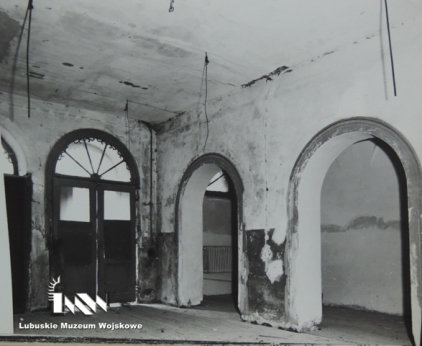
The condition of the palace hall, with its vaulted section separated by arcades (summer 1982) …
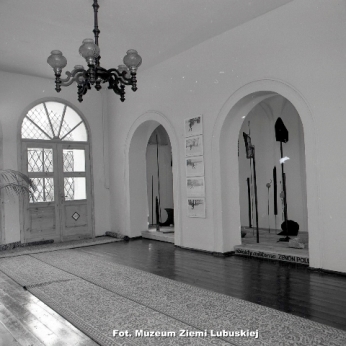
…and the same place four years later, following renovation. Today it looks quite different (a permanent exhibition of military hunting artefacts and a venue for temporary exhibitions).
The dilapidated palace required immediate major renovation. The work was undertaken during the difficult period of the country’s economic collapse in the early 1980s, which resulted in significant delays in the work and the use of poor-quality materials. Ultimately, the roof, chimneys and the terrace attached to the façade were renovated, and the palace’s foundations were protected against rising damp. All the façades were covered with new plaster and painted. Inside the building, the window and door frames, plumbing, electrical and central heating systems were replaced. The old floors were removed and new ones laid. Finally, all the rooms in the cellars, ground floor and part of the first floor were painted. However, after many years of use, the palace requires further renovation. The first phase (roof and window frames) was already completed at the start of this decade. The second phase (central heating system, new plasterwork on the façades) is awaiting its turn, and it would be advisable to carry it out as soon as possible so that the palace and the priceless collections housed within it may survive in good condition for at least the next few generations.
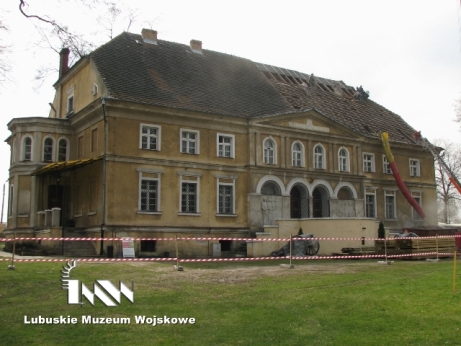
In the spring of 2012, renovation work began on the palace (the first such work since the major refurbishment in the early 1980s) – the roof covering, all the window frames and some of the door frames were replaced.
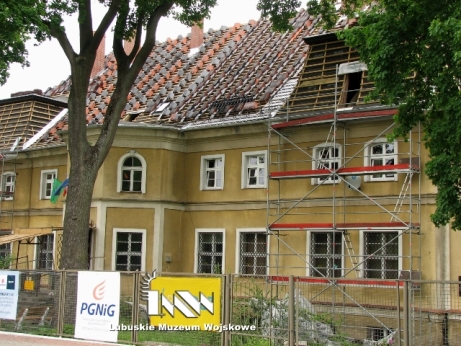
The replacement of the 747 m² roof covering also involved the arduous and technically complex replacement of certain ageing elements of the roof truss (including rafters and purlins).
Text: Tadeusz Blachura
Photos: T. Blachura, LMW archives, Lubusz Land Museum in Zielona Góra, internet