



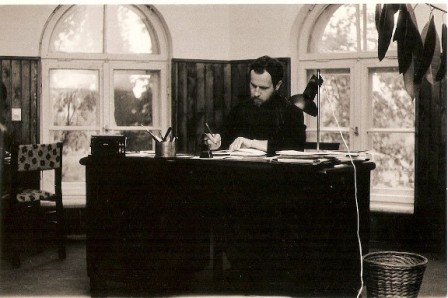
Włodzimierz Kwaśniewicz in his office at the palace in Drzonów. Photo: Lubusz Land Museum collection
From one chance encounter to the next: the beginning of the adventure with Drzonów
“For a historian, creating a museum is the adventure of a lifetime… to create a museum that first took shape in the mind and heart, and later this dream museum became a reality. I was very fortunate… this museum is my fortune, it is the most important part of my life” (excerpt from an interview by K. Stanglewicz with Dr Włodzimierz Kwaśniewicz for Radio Zachód)
In 1976, Włodzimierz Kwaśniewicz, as a PhD student at Adam Mickiewicz University in Poznań, found employment at the Museum of the Lubusz Region in Zielona Góra. He initially worked in the Education Department, and later took up the post of head of the Wine Department… although his main interest lay in historical weapons, particularly the history of the sabre in Poland, a subject he had written about in his doctoral thesis. He soon, however, recognised an opportunity to pursue his passion professionally. The director of the MZL at the time was Jan Muszyński, who had a vision of establishing specialist museum facilities around Zielona Góra. This vision, in turn, stemmed from the museum’s acquisition of historic palaces in Ochla, Świdnica and Drzonów, which in the 1970s stood unused and were threatened with irreversible destruction. At the same time, local authorities were discussing the need to create a museum commemorating the battles of 1945. Consequently, in 1978, a new ‘Brotherhood in Arms’ Department was established within the MZL, to which W. Kwaśniewicz was transferred. He began the process of acquiring exhibits, including heavy military equipment. Whilst searching for a place to store them, even temporarily, he found himself (for the first time in his life) in Drzonów and saw a deserted and somewhat dilapidated palace.
The development of the museum and the collection of heavy military equipment
“… and with his workaholic nature, he started travelling all over Poland… if Włodek were allowed to, he’d fill the whole village with cannons, tanks and rockets” (excerpt from an interview by K. Stanglewicz with Dr Jan Muszyński for Radio Zachód)
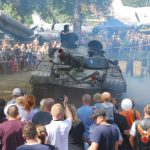
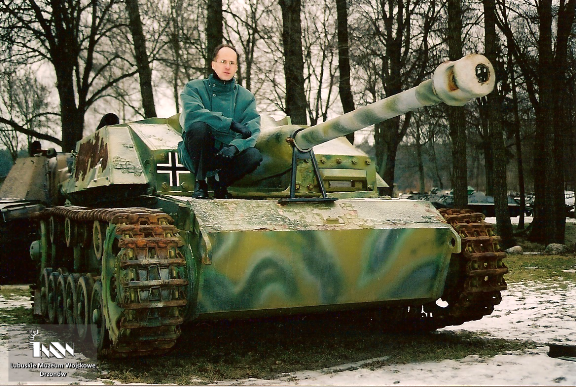
The beginnings of the heavy military equipment collection were spectacular. In 1979, an SM-2 helicopter landed on the meadow by the palace, with W. Kwaśniewicz himself on board. Soon, the then-legendary T-34-85 tank, known to everyone from the TV series “Four Tank-Men and a Dog”, and the mighty Il-28 jet bomber appeared at the palace. From 1985, Drzonów became the first museum in Poland to display a MiG-21 aircraft. The exhibits were sourced primarily from military stocks, training grounds and memorial plinths. Military equipment used in the economy was also collected. The chassis of the ISU-122 self-propelled gun stood at a state-owned farm in Lower Silesia, where it had been used for years to compact silage, whilst a Chevrolet Canada lorry served as a storage facility at one of the market stalls. He proudly repeated that the Drzonów collection of heavy military equipment was, in its day, the second-largest collection of its kind in Poland, containing many unique items.
At the same time, W. Kwaśniewicz was tackling the complete renovation of the palace, its conversion for museum use, the creation of exhibitions and the construction of an exhibition pavilion!
He fell so deeply in love with Drzonów that he eventually settled there for nearly a decade, and together with his wife Ewa, they looked after the palace and the museum park. He served as the museum’s director from its official establishment in 1985 until his retirement in 2012. In retirement, he continued to support his museum. From 2014, he was president of the Friends of the Museum Society.
Writing about old weapons
“We even called him a woodpecker at one stage. Because every time you walked down the corridor, you could hear Włodek typing… we used to say that only Włodek was fit to be a curator, and later the director of the military museum, because he typed at the speed of a machine gun” (excerpt from an interview by K. Stanglewicz with Dr Jan Muszyński for Radio Zachód)
The figure of W. Kwaśniewicz is associated not only with the museum, but also, and perhaps above all, with a series of his academic and popular science publications on historical weapons and protective armour. He wrote dictionaries and encyclopaedias of weaponry terminology that were in great demand at the time, as well as works on the history of sabres and their users in Poland. These works, often published by Bellona, could be found (and some can still be found today) in bookshops across the country. Among enthusiasts of antique weapons, he was regarded as a mentor and guru. He was also a court expert in the fields of art history and weaponry. He continued to provide expert reports and opinions on weapons almost until the end of his life. He was a natural storyteller, which meant he was often seen or heard in the local media.
Publications
- 1000 Words on Edged Weapons and Protective Armour, Warsaw 1981, 2nd ed. Warsaw 1989
- 1000 Words on Early Firearms, Warsaw 1987
- Through a Collector’s Eyes: Tales of Early Weapons, Zielona Góra 1987
- The Polish Sabre from the 15th to the End of the 18th Century: Sketches on Construction, Typology and Symbolism, Zielona Góra 1988
- Five Centuries of the Polish Sabre, Warsaw 1993
- From Knight to Veteran: A Dictionary of Historical Military Formations, Roles, Institutions and Ranks, Zielona Góra 1993
- History Written with a Sabre: The Sabres of Famous Poles of the First and Second Republics, Zielona Góra 1998
- A Lexicon of Edged and Projectile Weapons, Warsaw 2003
- A Lexicon of Early Firearms, Warsaw 2004
- A Lexicon of Early Protective Armour, Warsaw 2005
- Polish Sabres, St Petersburg 2005
- Sabres of Famous Poles, Warsaw 2006
- The History of the Sabre in Poland, Zielona Góra 1993, 2nd ed. Warsaw 2001, 3rd ed. Warsaw 2007
- Encyclopaedia of Ancient Weapons and Protective Armour, Warsaw 2017
Honorary Citizen of Zielona Góra
W. Kwaśniewicz was born and raised in Zielona Góra. His involvement in the Makusynów Scout troop had a profound influence on his character. It was there that he met his tutor and mentor, Zbigniew Czarnuch, of whom he said: “It is because of Zbyszek that I became a museum curator and historian; it is his fault.” He was active in voluntary work and held positions on the boards of, amongst others, the League of National Defence, the Friends of the Philharmonic Society, the Friends of the Lubuskie Military Museum Society, the Association of Reserve Officers of the Republic of Poland, the Polish Writers’ Union, and the Society for the Commemoration of the Greater Poland Uprising. For his activities, he was awarded, amongst others:
the “Drummer of the Greater Poland Uprising” statuette
the Knight’s Cross of the Order of Polonia Restituta
the title of Honorary Citizen of Zielona Góra
the title of Honorary Citizen of the Municipality of Świdnica
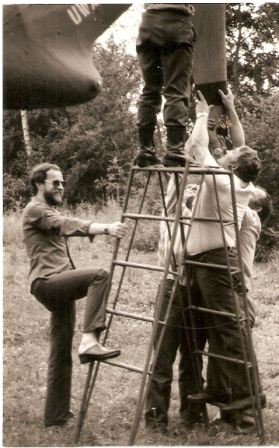
Photo: Collection of the Lubusz Region Museum
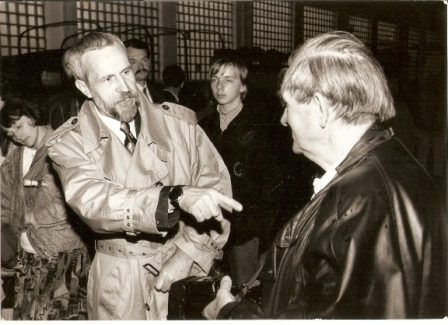
W. Kwaśniewicz in conversation with Marian Krzyżan. Collections of the Lubusz Region Museum
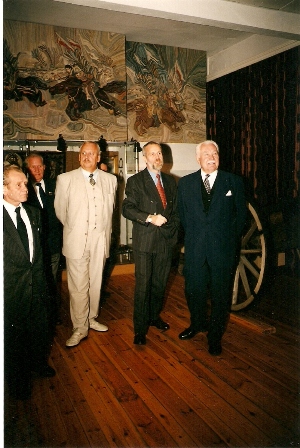
W. Kwaśniewicz giving a guided tour to a delegation led by Ryszard Kaczorowski. Photo: J. Sobociński
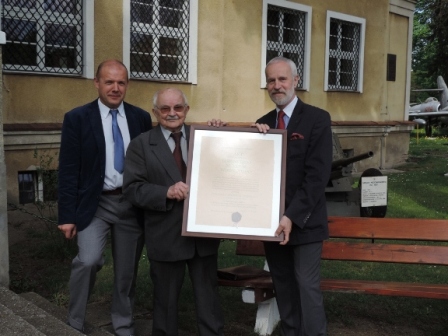
The 30th anniversary of the museum’s founding. Pictured with the founding charter, from left to right: Piotr Dziedzic, Zbyszko Piwoński and Włodzimierz Kwaśniewicz. Photo: J. Sobociński
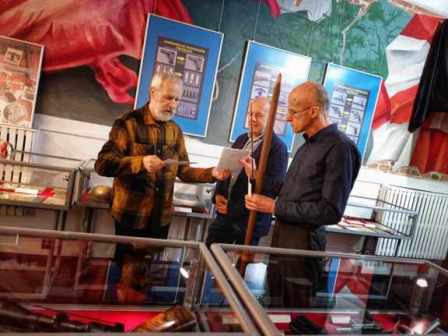
Otwarcie wystawy Najnowsze NabytkOpening of the exhibition ‘Latest Acquisitions’ in Drzonów. Photo: B. Mościpan, 2024.i w Drzonowie. Fot. B. Mościpan 2024 r.